

History graph card
The history graph card allows you to display a graph for each of up to eight entities.
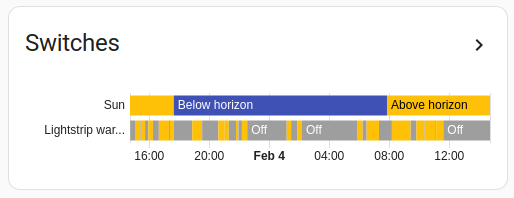 Screenshot of the history graph card, when the sensor has no `unit_of_measurement` defined.
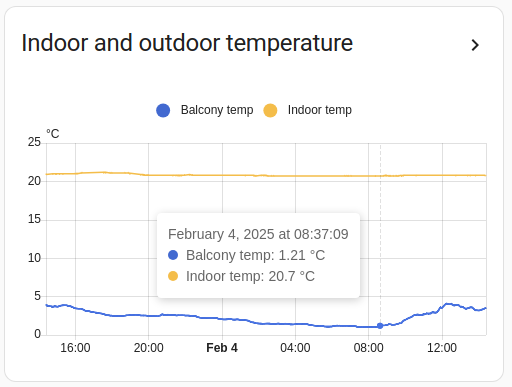 Screenshot of the history graph card, when the sensor has a `unit_of_measurement` defined.
You can configure all options for this card in the card editor. To choose where entity names appear, turn on Show entity names. Then, under Label position, select Beside the graph or Below each bar. Label position appears only when at least one entity is shown as bars.
Adding the history graph card to a dashboard
- In the top right of the screen, select the edit
button. - If this is your first time editing a dashboard, the Edit dashboard dialog appears.
- By editing the dashboard, you are taking over control of this dashboard.
- This means that it is no longer automatically updated when new dashboard elements become available.
- Once you’ve taken control, you can’t get this specific dashboard back to update automatically. However, you can create a new default dashboard.
- To continue, in the dialog, select the three dots
menu, then select Take control.
- If this is your first time editing a dashboard, the Edit dashboard dialog appears.
- Add a card and customize actions and features to your dashboard.
YAML configuration
The following YAML options are available when you use YAML mode or just prefer to use YAML in the code editor in the UI.
Configuration Variables
Hours to show in graph. Minimum is 1 hour. Big values can result in delayed rendering, especially if the selected entities have a lot of state changes.
Position of the entity names in timeline graphs. Can be side or below. With side, names are shown in a column next to the timeline. With below, each name is shown under its bar, like in the History panel, and each row takes more space. If you resized the card, you might need to give it more rows. Has no effect when show_names is false.
If true, numerical values on the Y-axis will be displayed with a logarithmic scale.
If true, configured Y-axis bounds would automatically extend (but not shrink) to fit the data.
Options for entities
If you define entities as objects instead of strings, you can add more customization and configuration:
Configuration Variables
Overwrites the default name of the entity. Can be a string, or a name configuration object. See naming documentation.
Long term statistics
Home Assistant saves long-term statistics for a sensor if the entity has a state_class of measurement, total, or total_increasing. For long-term statistics, an hourly aggregate is stored from the sensor history. Long-term statistics are never purged.
In the history graph card, if the hours to show variable is set to a figure higher than the recorder retention period, long-term statistics will backfill the older parts of the history graph, with more recent actual sensor values from the recorder shown in bold.
Examples
type: history-graph
title: 'My Graph'
entities:
  - sensor.outside_temperature
  - entity: media_player.lounge_room
    name: Main player
Or with longer time frame, and multiple entities (as long as they share the same unit_of_measurement) in one graph:
type: history-graph
title: "Temperatures in the last 48 hours"
hours_to_show: 48
entities:
  - sensor.outside_temperature
  - entity: sensor.lounge_temperature
    name: "Lounge"
  - entity: sensor.attic_temperature
    name: "Attic"